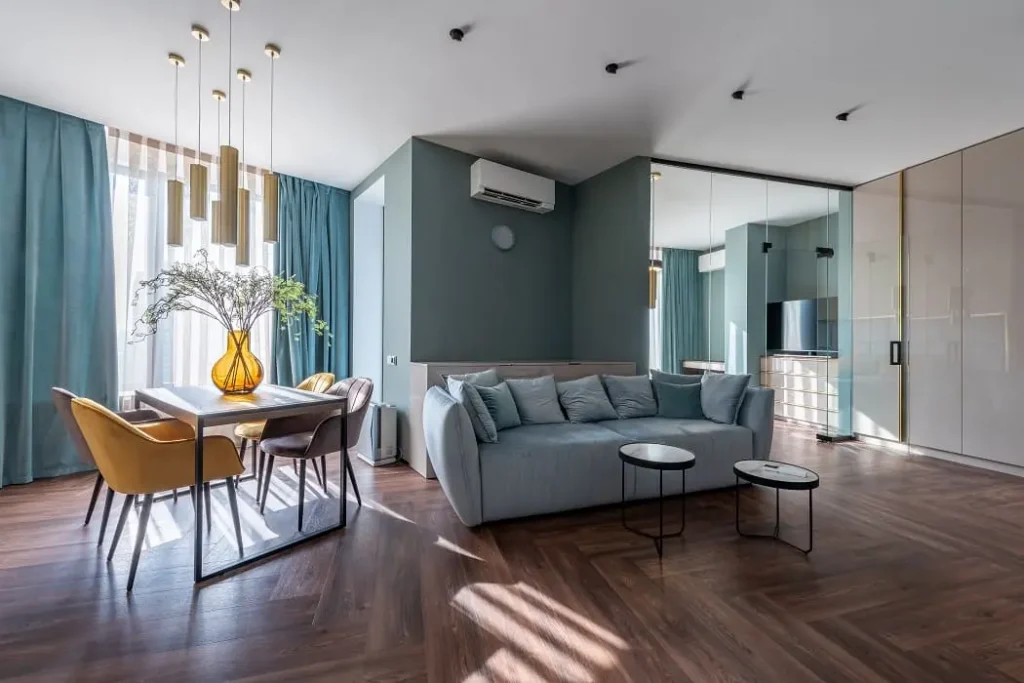
Definition and Calculation of Living Area
Our real estate agency in Paris's 16th arrondissement, CENTURY 21 Auteuil Immobilier has taken a detailed look at the definition of living area in real estate, its importance, and how it is calculated during a property appraisal.
What is living space?
The living area of an apartment or house refers to the interior space that can be used for daily activities. It is the space in which residents live, move about, and carry out their activities, excluding non-habitable spaces such as walls, partitions, stairwells, unfinished basements, unusable attics or lofts, etc., it therefore refers to the actual living space.
The concept of floor area is crucial in real estate, as it influences the valuation of a property, whether it is an apartment or a house. It is also used in setting rent and sale prices, as well as in calculating property taxes.
Local authorities often use living area to calculate property taxes, which means that properties of similar sizes may have different tax liabilities depending on their living area.
In addition, when setting rent, landlords use the living area to determine the amount of rent they can charge. A larger living area generally means a higher rent, taking into account also the utilities and therent control.
It is important to note that many local regulations establish minimum living space standards to ensure the safety and comfort of residents. Compliance with these standards is essential for selling or renting a property.
The size of the living area and the ceiling height have a direct impact on the occupants’ comfort and quality of life. An insufficient living area can lead to a feeling of cramped quarters and may be considered substandard housing.
In real estate law, the living area of a dwelling is defined by Article Section 111-2 of the Building and Housing Code as follows:
“…The living area of a dwelling is the total floor area, after deducting the areas occupied by walls, partitions, steps and stairwells, utility shafts, and door and window openings; the living volume corresponds to the total of the living areas thus defined multiplied by the ceiling heights. The area of unfinished attics, cellars, basements, storage rooms, garages, terraces, loggias, balconies, outdoor drying areas, verandas, glazed spaces as defined in Article R. 111-10, common areas, and other outbuildings associated with the dwelling, nor are parts of rooms with a ceiling height of less than 1.80 meters taken into account.”
How do you calculate the living area of a home?
Living area is calculated in square meters by multiplying the width by the length of each interior room in the house or apartment, and then adding up the area of each room to obtain the total area. Of course, non-habitable spaces such as exterior walls, stairwells, unusable attics, unfinished basements, balconies, and porches are not included in this calculation.
Which parts are included in the calculation?
All enclosed rooms are included in the calculation of living area, such as living rooms, kitchens, bedrooms, bathrooms, hallways, and closets.
What is not included in the living area?
However, spaces with a ceiling height of less than 1.80 meters are not included, nor are balconies and terraces, exterior walls, stairwells, attics, unfinished basements (including cellars), door and window openings, storage areas (including garages), and sunrooms.
What are the specific aspects of calculating living space?
The calculation of living area is governed by laws, the Carrez Law and the Boutin Law, which varies depending on whether you want to sell or rent your house or apartment. In any case, you must hire a professional surveyor who has the necessary expertise and measuring equipment and who will be able to provide an accurate and reliable measurement of your property in compliance with the law.
These laws are designed to protect the rights of tenants and buyers by ensuring that they pay a fair rent or purchase price based on the actual living area.
Under the Carrez Law, to put a condominium unit For residential units larger than 9 m², only enclosed areas with a ceiling height of more than 1.80 m are to be included in the calculation, based on floor area.
The Boutin Law, passed in 2009, requires landlords to inform their tenants of the living area made available to them at the time of the lease, in order to protect the tenant, since the square footage must meet legal standards for decent housing, which stipulate that the dwelling must include at least one main room, have a minimum area of 9 square meters, and a ceiling height of at least 2.20 meters.
Living Area and Ceiling Height
When calculating the square footage of a property, one of the key factors is ceiling height. In order to sell or rent your house or apartment, the ceiling height must meet certain standards and be at least 1.80 meters for the dwelling to be considered decent.
For older properties, ceiling height can vary and is defined by measuring the distance between the floor and the finished ceiling—that is, without taking suspended ceilings into account. In new homes, however, the ceiling height is standardized at 2.50 meters.
Living space and garage: Is it included?
Since a residential garage is intended exclusively for parking a vehicle, it is not considered living space. The same applies to basements and unfinished attics. A garage may exceptionally be included in the living area only if it has been converted into a habitable room with windows, a ceiling height of at least 1.80 meters, and proper insulation.
Living Space and Closets: What Are the Rules?
Under the Carrez Law, whether built-in closets are included in the calculation of living area depends on their size, whether they are built into a wall, and whether they affect the total area of the dwelling. If the floor of the closet is at the same level as that of the room, only the interior portion is to be included in the calculation.
Living Area and Hallway: How Are They Calculated?
The hallway is included in the calculation of a home’s living area, just like the kitchen or the bathroom; since living area refers to habitable space, the hallway is part of it.
Living Space and Laundry Room: How Are They Calculated?
To determine whether the laundry room in your apartment or house is included in the living area, it must be considered a room defined by a floor, a ceiling, and walls.
Living Area and Staircases: How Are They Calculated?
A staircase may be included in the living area only if its ceiling height is greater than 1.80 m. It is also important to note that the space beneath a freestanding staircase may also be included in the calculation of the living area. However, the steps and the stairwell are excluded.