How do I get to the 16th arrondissement of Paris by bus, metro, RER, or tram?
Whether you're coming from downtown Paris or the nearby suburbs, our real estate agency in Paris's 16th arrondissement, Century 21 Auteuil Immobilier offers several options for easily reaching the 16th arrondissement.
Metro lines in the 16th arrondissement
Every neighborhood in the 16th arrondissement is easily accessible via several metro lines, and this connectivity enhances their appeal and is a major draw for those looking to live or settle there. You can quickly reach the various neighborhoods and arrondissements of Paris and even beyond.
What expenses can a landlord recover from a tenant?
The landlord may recover from the tenant various types of expenses related to the tenant’s occupancy of the dwelling. These are primarily costs associated with services from which the tenant directly benefits.
These recoverable expenses include costs associated with essential services such as water, the elevator, and central heating. Expenses for maintenance and minor repairs to common areas are also included, provided they do not result from construction defects or structural flaws in the building.
The tenant must also contribute to communal services such as household waste collection and sanitation. Specifically, these charges include the maintenance of elevators and freight elevators, the supply of hot and cold water, central heating for private and common areas, as well as the maintenance of interior common areas and green spaces. The salaries of the building staff or the superintendent (in part) are also included in these recoverable charges.
Line 1
Line 1, the first line in the French metro system to open in 1900 for the World’s Fair, is one of the busiest lines in the Paris metro system. It connects La Défense Station to Château de Vincennes Station, serves the Porte Maillot neighborhood, crosses Paris, and provides quick access to its iconic landmarks such as the Champs-Élysées, the Louvre, the Place de la Concorde, City Hall, and the Marais district, making it easier for residents, workers, and tourists to get around.
With connections to 11 Metro lines, the RER A, B and D, the Transilien lines, L, R, and U, as well as lines T2, T3a, and T3b, Line 1 allows you to reach Gare de Lyon, Gare du Nord, and Charles de Gaulle and Orly airports via the RER B. This gives you a wide range of options for getting to the 16th arrondissement.
Line 2
Line 2, which began service in 1900 and was extended in 1903 to its current terminus at Nation, runs through western Paris and now connects Porte Dauphine to Nation. This line serves 25 stations. Thanks to its connections with other Metro and RER lines, it’s ideal for visiting Paris’s historic and cultural sites, such as the Sacré-Cœur, the Pigalle neighborhood, the Père Lachaise Cemetery, or the quintessentially Parisian neighborhoods of Ménilmontant and Belleville. Four stations on this line are elevated on a viaduct, making for a very pleasant ride.
Line 6
Line 6, which connects the Charles de Gaulle–Étoile and Nation stations, is a direct route between southwest and east Paris; half of the line runs above ground, offering an exceptional view of the Eiffel Tower as it passes through the Passy Station.
With 28 stations along the line, if you’d like to visit Paris, you can get off at any of the following stations: Trocadéro, Bir-Hakeim (for the Champ de Mars and the Eiffel Tower), Montparnasse, Bercy, or Nation.
There are numerous connections to 11 metro lines, the RER A and B lines, and the OrlyBus shuttles.
Line 9
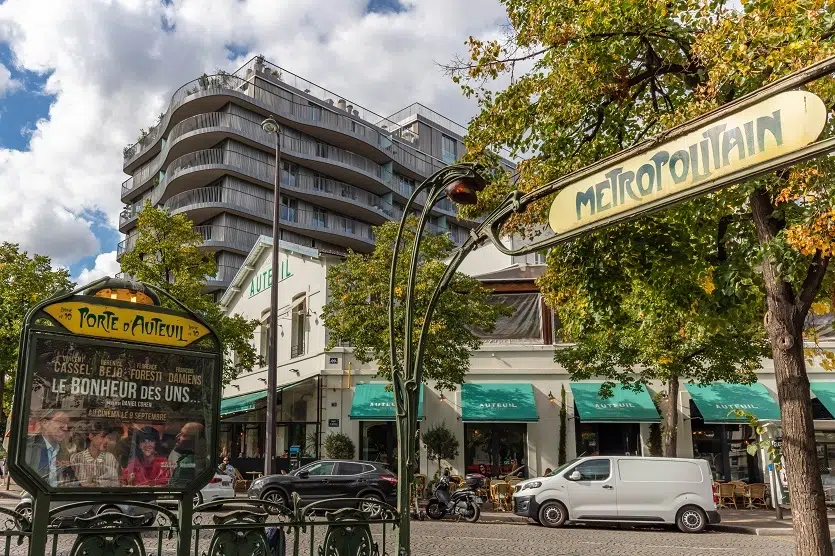
Line 9 is strategically important for the 16th arrondissement, serving several stations such as Trocadéro, La Muette, Jasmine, Michel-Ange Auteuil, Michelangelo Molitor, Porte de Saint-Cloud and Porte d’Auteuil, it makes it easier to travel to downtown Paris and the western suburbs.
One of the longest lines in the metro system, this line connects Boulogne-Billancourt to Montreuil: Starting at Pont de Sèvres station, it continues to Mairie de Montreuil station and serves famous tourist attractions and the capital’s “upscale” neighborhoods, such as the Pont de l’Alma, the department stores, Place de la République, and the Champs-Élysées… Well known to avid soccer fans for its Porte de Saint-Cloud station, it provides access to the Parc des Princes.
With 37 stations, this line offers numerous connections and provides access to the Austerlitz Station via Line 10 by getting off at Michel Ange Molitor or at Porte d’’Auteuil, which provides access to major sports venues such as the Roland Garros Stadium and the Jean-Bouin Stadium. From the Pont de Sèvre station, it's easy to take the T2 tram to La Défense.